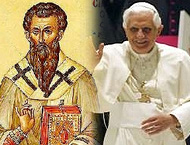
Tuesday, 3 January 2012

Belloc and the Nature of Belief

Here is another of Belloc's purple passages from The Path to Rome on "the nature of Belief":

"Of its nature it breeds a reaction and an indifference. Those who believe nothing but only think and judge cannot understand this. Of its nature it struggles with us. And we, we, when our youth is full on us, invariably reject it and set out in the sunlight content with natural things. Then for a long time we are like men who follow down the cleft of a mountain and the peaks are hidden from us and forgotten. It takes years to reach the dry plain, and then we look back and see our home.

"What is it, do you think, that causes the return? I think it is the problem of living; for every day, every experience of evil, demands a solution. That solution is provided by the memory of the great scheme
which at last we remember. Our childhood pierces through again... But I will not attempt to explain it, for I have not the power; only I know that we who return suffer hard things; for there grows a gulf between us and many companions. We are perpetually thrust into minorities, and the world almost begins to talk a strange language; we are troubled by the human machinery of a perfect and superhuman revelation; we are over-anxious for its safety, alarmed, and in danger of violent decisions.

"And this is hard: that the Faith begins to make one abandon the old way of judging. Averages and movements and the rest grow uncertain. We see things from within and consider one mind or a little group as a salt or leaven. The very nature of social force seems changed to us. And this is hard when a man has loved common views and is happy only with his fellows.

"And this again is very hard, that we must once more take up that awful struggle to reconcile two truths and to keep civic freedom sacred in spite of the organization of religion, and not to deny what is certainly true. It is hard to accept mysteries, and to be humble. We are tost as the great schoolmen were tost, and we dare not neglect the duty of that wrestling.

"But the hardest thing of all is that it leads us away, as by a command, from all that banquet of the intellect than which there is no keener joy known to man.

"I went slowly up the village place in the dusk, thinking of this deplorable weakness in men that the Faith is too great for them, and accepting it as an inevitable burden. I continued to muse with my eyes upon the ground...

"There was to be no more of that studious content, that security in historic analysis, and that constant satisfaction of an appetite which never cloyed. A wisdom more imperative and more profound was to put a term to the comfortable wisdom of learning. All the balance of judgement, the easy, slow convictions, the broad grasp of things, the vision of their complexity, the pleasure in their innumerable life--all that had to be given up. Fanaticisms were no longer entirely to be despised, just appreciations and a strong grasp of reality no longer entirely to be admired.

"The Catholic Church will have no philosophies. She will permit no comforts; the cry of the martyrs is in her far voice; her eyes that see beyond the world present us heaven and hell to the confusion of our human reconciliations, our happy blending of good and evil things.

"By the Lord! I begin to think this intimate religion as tragic as a great love. There came back into my mind a relic that I have in my house. It is a panel of the old door of my college, having carved on it my college arms. I remembered the Lion and the Shield, Haec fuit, Haec almae janua sacra domus. Yes, certainly religion is as tragic as first love, and drags us out into the void away from our dear homes.

"It is a good thing to have loved one woman from a child, and it is a good thing not to have to return to the Faith."

Monday, 2 January 2012

Belloc on the Mass


As I mentioned in my last post, I'm reading Belloc's The Path to Rome, which is full of wonderful purple passages. Here, for example, is what he has to say about "a day one has opened by Mass ... [which is] a source of continual comfort to me".


"This comfort I ascribe to four causes ... and these causes are:


1. That for half-an-hour just at the opening of the day you are silent
and recollected, and have to put off cares, interests, and passions in
the repetition of a familiar action. This must certainly be a great
benefit to the body and give it tone.

2. That the Mass is a careful and rapid ritual. Now it is the function
of all ritual (as we see in games, social arrangements and so forth)
to relieve the mind by so much of responsibility and initiative and to
catch you up (as it were) into itself, leading your life for you
during the time it lasts. In this way you experience a singular
repose, after which fallowness I am sure one is fitter for action and
judgement.

3. That the surroundings incline you to good and reasonable thoughts,
and for the moment deaden the rasp and jar of that busy wickedness
which both working in one's self and received from others is the true
source of all human miseries. Thus the time spent at Mass is like a
short repose in a deep and well-built library, into which no sounds
come and where you feel yourself secure against the outer world.

4. And the most important cause of this feeling of satisfaction is
that you are doing what the human race has done for thousands upon
thousands upon thousands of years. This is a matter of such moment
that I am astonished people hear of it so little. Whatever is buried
right into our blood from immemorial habit that we must be certain to
do if we are to be fairly happy (of course no grown man or woman can
really be very happy for long--but I mean reasonably happy), and, what
is more important, decent and secure of our souls. Thus one should
from time to time hunt animals, or at the very least shoot at a mark;
one should always drink some kind of fermented liquor with one's
food--and especially deeply upon great feast-days; one should go on
the water from time to time; and one should dance on occasions; and
one should sing in chorus. For all these things man has done since God
put him into a garden and his eyes first became troubled with a soul.
Similarly some teacher or ranter or other, whose name I forget, said
lately one very wise thing at least, which was that every man should
do a little work with his hands.

Oh! what good philosophy this is, and how much better it would be if
rich people, instead of raining the influence of their rank and
spending their money on leagues for this or that exceptional thing,
were to spend it in converting the middle-class to ordinary living and
to the tradition of the race. Indeed, if I had power for some thirty
years I would see to it that people should be allowed to follow their
inbred instincts in these matters, and should hunt, drink, sing,
dance, sail, and dig; and those that would not should be compelled by
force.

Now in the morning Mass you do all that the race needs to do and has
done for all these ages where religion was concerned; there you have
the sacred and separate Enclosure, the Altar, the Priest in his
Vestments, the set ritual, the ancient and hierarchic tongue, and all
that your nature cries out for in the matter of worship."


Later on, he describes going to Mass on the feast of Corpus Christi and comments approvingly that "the Mass was low and short - they are a Christian people". 


I don't want to draw any facile conclusions but it seems that, for Belloc, "the sacred and separate Enclosure, the Altar, the Priest in his Vestments, the set ritual, the ancient and hierarchic tongue" were not incompatible with the "low and short". For him the Mass could be both "careful" and "rapid".


But all this is to see Belloc with early 21st Century eyes. What really mattered then, as it matters now, was the Mass itself and its "continual comfort".

Sunday, 1 January 2012

A New Year Message from Hilaire Belloc


Since everybody else seems to be giving a New Year message, I thought I'd give Belloc a chance.

This is from his 1902 The Path to Rome, which I'm reading at the moment in the wonderful Penguin edition:

"Then I went on my way, praying God that all these rending quarrels might be appeased. For they would certainly be appeased if we once again had a united doctrine in Europe, since economics are but an expression of the mind and do not (as the poor blind slaves of the great cities think) mould the mind."

Saturday, 31 December 2011

New Year


Here's a great New Year poem from Denise Levertov.

You can also see and hear her reading some of her poems here.

Wednesday, 28 December 2011

José Tolentino Mendonça

A couple of weeks ago the Pope appointed new members and consultors to the Pontifical Council for Culture. 


What was interesting about these appointments was a) how wide-ranging the Vatican's definition of Culture is (among the consultors were professors of neurology, physics, and astrophysics) b) how high profile some of these appointments were (Arvo Pärt being the standout figure) and c) how poets rather than novelists represented the literary arts.


I will write shortly about Catholicism and the novel but, for now, let's look at the poet (and theologian) who was named as a consultor, Fr José Tolentino Mendonça. You can read about his work here and can read one of his poems (which is partly about Flannery O'Connor) here.


If you ever need a lesson on how to not use the comma, Mendonça's the man.

Wednesday, 21 December 2011

Image Journal: Poems for the Season


Image Journal is an interesting publication with an interesting blog. If you're looking for some festive poems they have some good recommendations here.

Sunday, 18 December 2011

The Father Christmas Letters


Tolkien's The Father Christmas Letters - also published in more detail as Letters from Father Christmas - are quite fun, though not in anything like the same league as The Lord of the Rings. The title is also slightly misleading. The letters are indeed from Father Christmas (to Tolkien's children) but Father Christmas is not quite as significant in most of the letters as the North Polar Bear, his accident-prone helper, though I suspect that it is Tolkien's pictures rather than his tales or his characters which are the chief attraction for many children.

I was intrigued by one minor detail though. Tolkien is very precise about the date of the last major Goblin attack - 1453 - which rather suggests a link with the Ottoman Turks who famously stormed Constantinople in that year. Now we have to be careful here: Tolkien claimed to hate allegory (though there is more than a whiff of it in stories like Farmer Giles of Ham and the wonderful Leaf by Niggle). The simple fact that the Goblins return to the North Pole during the dark days of World War II suggests that we cannot simply equate the Goblins with the Ottoman Turks. However, this simple fact also suggests that Tolkien's imagination was rather more allegorical than he sometimes claimed or would have liked.

One word of warning. You don't get all the letters in The Father Christmas Letters or even, I think, in some editions of Letters from Father Christmas, which can be rather frustrating.

Indeed, despite the enormous number of books published by and about Tolkien, there are still some gaps. I look forward to the day, for example, when we get a Collected Letters. What we have at the moment is only a selection with some significant lacunae. Take this example, for instance:

"Out of the darkness of my life, so much frustrated, I put before you the one great thing to love on earth: the Blessed Sacrament..... There you will find romance, glory, honour, fidelity, and the true way of all your loves upon earth, and more than that: Death: by the divine paradox, that which ends life, and demands the surrender of all, and yet by the taste (or foretaste) of which alone can what you seek in your earthy relationships (love, faithfulness, joy) be maintained, or take on that complexion of reality, of eternal endurance, which every man's heart desires."(pp.53-54)

I'd love to know what comes at the end of that first sentence. But, even with the gaps, these letters are really wonderful.

Monday, 12 December 2011

Dickens, Chesterton & Christmas


G. K. Chesterton wrote a series of brilliant introductions to Dickens' books, including his Christmas books, which are well worth reading at this time of year. You can find the relevant introductions here and here.

As you might guess, they are eminently quotable, so I have had to restrict myself to just a few of Chesterton's comments here. 

What he appreciates is that "Dickens devoted his genius in a somewhat special sense to the description of happiness. No other literary man of his eminence has made this central human aim so specially his subject matter." 

Which is why he was so attracted to Christmas, almost despite himself: "All Dickens's books," he writes,  "are Christmas books."

So what is so special about Christmas?

"Everything is so arranged that the whole household may feel, if possible, as a household does when a child is actually being born in it. The thing is a vigil and a vigil with a definite limit. People sit up at night until they hear the bells ring. Or they try to sleep at night in order to see their presents the next morning. Everywhere there is a limitation, a restraint; at one moment the door is shut, at the moment after it is opened. The hour has come or it has not come; the parcels are undone or they are not undone; there is no evolution of Christmas presents."

And why does the season matter?

"All comfort must be based on discomfort. Man chooses when he wishes to be most joyful the very moment when the whole material universe is most sad."

As he wrote about Dickens: "He may almost be said to have only written a brilliant introduction to another man's book."

Thursday, 8 December 2011

How to Read


I love this passage about reading from Steinbeck's East of Eden: "Samuel rode lightly on top of a book and he balanced happily among ideas the way a man rides white rapids in a canoe. But Tom got into a book, crawled and grovelled between the covers, tunnelled like a mole among the thoughts, and came up with the book all over his face and hands."

This thought from the Sayings of Light and Love by St John of the Cross (who is quoting Guigo the Carthusian who is, in turn, reworking Luke 11: 9) is wonderful in a different way: "Seek in reading and you will find in meditation; knock in prayer and it will be opened to you in contemplation." 

This fourfold approach is the basis of lectio divina but, it seems to me, it also has an application in the classroom. As English teachers we want our students to read but how they read is pretty important too.

Wednesday, 7 December 2011

Regina Derieva


Regina Derieva is an interesting poet. She was born in what is now Ukraine in 1949 and lived for many years in what is now Kazakhstan before converting to Catholicism, emigrating to Israel and then finding herself in a stateless condition. She now lives in Sweden and continues to publish to critical acclaim.

Thursday, 1 December 2011

Making the Most of Advent


This time last year I recommended the poetry of St Robert Southwell (and here) and Alice Thomas Ellis's The Birds of the Air. 

This year I have been slogging through her The Inn at the Edge of the World, a novel about a group of individuals who spend Christmas at a failing inn on a remote Scottish island in a vain attempt to escape the horrors of Christmas. As is typical of Thomas Ellis, there is more to the story than immediately meets the eye - selkie legends run through the story and a twist is coming - but I'm not enjoying it as much as I did The Birds of the Air simply because the characters are an eminently unlikeable lot.

So what else is available as we prepare for Christmas? I recommended a few books last November and a couple of children's books this year (here and here) but there's plenty more out there.

Denise Levertov's 'The Tide', for example, is presented as an Advent poem in one anthology of Catholic poetry. It's a good poem but I wonder if her poem about the Annunciation might not be a better bet at this time of year (as well as in March)? Levertov is a fantastic poet and not terribly well known, at least on this side of the pond.

Another option is Mauriac's 'A Christmas Tale', a story about Christmas, growing up and authorship, which is available in John B. Breslin's The Substance of Things Hoped For (along with some other great, and unusual, short stories.

Any other suggestions gratefully received.

Sunday, 27 November 2011

Rowan Williams meets Dostoevsky: Towards a Catholic Theory of Literature

In the introduction to his book about Dostoevsky: Language, Faith and Fiction, Rowan Williams, the Archbishop of Canterbury, writes about "Evelyn Waugh and Graham Greene (at least in much of his earlier work) as Catholic novelists, and we mean by this not that they are novelists who happen to be Catholics by private conviction, but that their fiction could not be understood by a reader who had no knowledge at all of Catholicism and the particular obligations it entailed for its adherents. Quite a lot of this fiction deals with what it is that makes the life of a Catholic distinct from other sorts of lives lived in Britain and elsewhere in the modern age. ... Some of it is about how the teachings of the Catholic Church, difficult and apparently unreasonable as it seems, is obscurely vindicated as the hand of God works through chaotic human interactions."

That last sentence is enough to make the hackles rise but, even if we discount it, Williams' definition seems rather curious. These novelists are Catholic but not catholic. They are defined by their differences. Their vision is narrow.

But surely that is simply not the case. Both Greene and Waugh are read and enjoyed by many readers who have very little interest in, sympathy for, or knowledge of, Catholicism. As Catholics, their vision was wide enough to take in everything from gang warfare to relics, from politics to humour, from heaven to hell and everything in between.

This is precisely why Greene so disliked being labelled as a "Catholic novelist". But, if we are to reach towards a Catholic theory of literature, we have not only to be catholic in our own reading (as I suggested in my last post) but we have to allow Catholic novelists (and poets) to be catholic too. If Catholicism means anything at all it means everything.

To be fair to Williams, he does at least identify another type of Catholic novelist - represented by Flannery O'Connor, Walker Percy, Muriel Spark, and Alice Thomas Ellis - whose books are less obviously Catholic but whose "work is about the possibility of any morally coherent life in a culture of banality and self-deceit." Williams feels more at home with this second group but, in using them as a way into Dostoevsky, he surely does a great disservice to Greene and Waugh.

But I mustn't end on a negative. It is encouraging to English teachers everywhere that both the Pope and the Archbishop of Canterbury are prepared to spend time reading and writing. In fact Rowan Williams thought this one was so important that he took a sabbatical to write it.

If you want to read more about his book click here or here or here.

Monday, 21 November 2011

Benedict meets Basil: Towards a Catholic Theory of Literature

Is it possible to have a Catholic theory of literature?

Over the next few weeks I shall try to explore a few different approaches, starting with one suggested by Pope Benedict in his General Audience on St Basil:

"Basil," he said, "was of course also concerned with that chosen portion of the People of God, the youth, society's future. He addressed a Discourse to them on how to benefit from the pagan culture of that time.

He recognized with great balance and openness that examples of virtue can be found in classical Greek and Latin literature. Such examples of upright living can be helpful to young Christians in search of the truth and the correct way of living (cf. Ad Adolescentes 3).

"Therefore, one must take from the texts by classical authors what is suitable and conforms with the truth: thus, with a critical and open approach - it is a question of true and proper "discernment"- young people grow in freedom.

"With the famous image of bees that gather from flowers only what they need to make honey, Basil recommends: "Just as bees can take nectar from flowers, unlike other animals which limit themselves to enjoying their scent and colour, so also from these writings... one can draw some benefit for the spirit. We must use these books, following in all things the example of bees. They do not visit every flower without distinction, nor seek to remove all the nectar from the flowers on which they alight, but only draw from them what they need to make honey, and leave the rest. And if we are wise, we will take from those writings what is appropriate for us, and conforms to the truth, ignoring the rest" (Ad Adolescentes 4).

"Basil recommended above all that young people grow in virtue, in the right way of living: "While the other goods... pass from one to the other as in playing dice, virtue alone is an inalienable good and endures throughout life and after death" (Ad Adolescentes 5).

"Dear brothers and sisters, I think one can say that this Father from long ago also speaks to us and tells us important things.

"In the first place, attentive, critical and creative participation in today's culture.

"Then, social responsibility: this is an age in which, in a globalized world, even people who are physically distant are really our neighbours; therefore, friendship with Christ, the God with the human face.

"And, lastly, knowledge and recognition of God the Creator, the Father of us all: only if we are open to this God, the common Father, can we build a more just and fraternal world."

To read the whole of St Basil's Address to Young Men on the Right Use of Greek [i.e. pagan] Literature click here.

Friday, 11 November 2011

Preparing for Advent: Frank McCourt


Another good book for younger students in the run up to Christmas is Angela and the Baby Jesus by the Pulitzer Prize-winning author, Frank McCourt. McCourt's relationship with the Church was sometimes turbulent (as this interview makes clear) but Angela and the Baby Jesus is a delightful, true story straight from his good Irish Catholic mother. You can read a full review from the New York Times here and you can hear McCourt talking about the inspiration for the book in the following recording, though the sound quality, I'm afraid, is not great.

Wednesday, 9 November 2011

Mary Douglas

I realise that it's rather off-topic but I want to write a few words (OK, quite a lot of words) about the great Catholic anthropologist, Mary Douglas, before suggesting a few literary links at the end.
When she died in 2007, Prospect Magazine had this to say about her: “Few thinkers have changed how we see the world; even fewer have changed how we think about how we see the world. Mary Douglas, who has died aged 86, is one of the rare exceptions. Her field was culture, but she was as unlike the stereotypical cultural studies academic as one could imagine. A devout Catholic, she spent the last few decades in an extraordinary flowering of inquiry that is now providing insights in fields as diverse as the study of the Old Testament and the politics of climate change.”
It was, in part, the immense range of her writings that made Mary Douglas such a profoundly important figure in British intellectual life in the second half of the Twentieth Century. She wrote books about Purity and Danger, Natural Symbols, Risk and Blame, How Institutions Think, and articles on everything from jokes to good taste, from drink to implicit meanings.

In a fascinating conversation with the historian and anthropologist, Professor Alan McFarlane, she spoke about the influence her convent education had had on her work: the nuns “were very interested in getting us married and they weren’t interested in us getting academic qualifications. But in order to get a grant they had to come up to certain educational standards and be certificated as a teaching school so in fact they were brilliant. Not just one, I had a series of really brilliant women teachers.”

In fact she goes so far as to describe three of her teachers as “quite outstanding intellectuals as well as teachers” and claimed that “to rise up to their standards was quite a challenge”. She also describes having a doctrine class every day which was so special that the students had to wear gloves: “We loved those lessons because the nun was so enthusiastic.”

Brown cotton gloves were also worn out of respect for the Blessed Sacrament whenever the girls went to chapel, while on Feast Days the pupils wore white clothes and white gloves. Some of the trenchant points she made about Friday abstinence in Natural Symbols were surely derived, on one basic level at least, from her experiences at the Convent of the Sacred Heart at Roehampton.

Indeed she became interested in social studies because all pupils were required to take a certificate in Catholic Social Teaching, based on the papal encyclicals. However, the nuns thought Sociology was anti-God and anti-religion so they wouldn’t send her to the LSE. She had to make do with PPE at Oxford instead!

So what has all this got to do with the Catholic English teacher? Three things, I think.

1. Mary Douglas wrote explicitly about literature in her last book, Thinking in Circles.

2. In her last years she also wrote about the Bible from a literary as well as an anthropological perspective: Leviticus as Literature, for example, is a fascinating book because of the multi-disciplinary approach Mary Douglas adopts.

3. Mary Douglas was educated at the same Sacred Heart school as Antonia White but the description she gives of her convent education is quite different from that given by White in Frost in May. I wouldn't wholly knock Frost in May, though I don't like the way it's been used to knock convent education across the board. However, while it's worth remembering that White later returned to her Catholic faith, as described in The Hound and the Falcon, it's also worth remembering that there were others, like Mary Douglas, whose experiences were much more positive from the start.

I'm not naive enough to think that very much of this will ever find its way into the English classroom but I do think that Mary Douglas is a great model of the committed Catholic intellectual and that her books are still very much worth reading. But don't worry: it's back to fiction for my next post.

Monday, 7 November 2011

Frank Cottrell Boyce on Newman


Frank Cottrell Boyce, the author of Millions among many other great children's books, gave a lecture last week on Newman. As you might expect from Cottrell Boyce, it was both witty and thought-provoking. You can download a PDF of the lecture or listen online. Both are worth doing.

Sunday, 6 November 2011

Preparing for Advent: Michael Morpurgo and Quentin Blake


Michael Morpurgo and Quentin Blake are among Britain's most best-loved children's authors, so On Angel Wings, a retelling of the Christmas story by Morpurgo with illustrations by Blake, is a pretty surefire winner.

This short book tells the story of the shepherd boy who is left behind to watch over the sheep while the rest of the shepherds travel to Bethlehem to visit the infant Jesus. However, when Gabriel returns for him he becomes the first visitor at the stable and the first to give a gift. It's a charming and thought-provoking take on the original and one that I think I'll be reading to my Year 7s (11-year olds) in the last lesson before the Christmas holiday.

Blake's pictures, which will be familiar to anyone who has read Roald Dahl's books even if they haven't come across Blake's own wonderful books, complement the text as well as you would imagine and there's even a dramatised version coming up at the National Theatre on 21st December.

My only quibble, as with so many modern books that deal with angels, is that familiarity too easily replaces awe: "I'm sorry to drop in on you unexpectedly like this," are Gabriel's first words to the shepherds. But I'll try not to quibble too much. On Angel Wings is a welcome book for anyone looking for a good book for their children or their students for Christmas.

Thursday, 3 November 2011

Lord of the Flies


A little while back I set myself a literary challenge. I've now decided that a side of A4 is not enough but I have restricted myself to two sides. I'm currently working my way back through the 20th Century and here's my analysis of part of the final chapter of Lord of the Flies.

William Golding was the master of the unexpected ending. In many of his novels there is an unexpected change of perspective in the final chapter which makes the reader reconsider all that has gone before. In Pincher Martin, for example, it is only right at the very end of the novel that we realise that the sailor whom we believed to have been struggling for survival throughout the novel has been dead all along. And in The Inheritors, a novel in which we follow a wonderful group of Neanderthals, it is quite a shock when, in the last chapter, we see them through the eyes of homo sapiens, through our eyes in effect, as nothing more than “strange creature[s], smallish, and bowed.”

In his most famous novel, Lord of the Flies, the change of perspective comes shortly after the children have completed their descent into savagery. At the start of the novel their plane comes down during what is presumably World War III and they find themselves stranded without adults on a desert island. But gradually their bestial nature comes to the fore and two of the boys, including the one nicknamed Piggy, are killed. As the book draws to a close, a murderous hunt is underway for Ralph, the group’s former leader.

Just as he is about to be killed, the boys stumble across a British naval officer and, suddenly, we see them as they are: a bunch of unruly children. But they are no longer mere children. Like the adults who have been tearing each other apart in a nuclear war, they have discovered “the end of innocence, the darkness of man’s heart” - original sin if you like – and, in a wonderfully bathetic moment, they burst into tears.

The final irony, of course, is that the officers who discover them, men whose only response is to turn away “to give [the children] time to pull themselves together”, are no better than savages themselves. They may have neat uniforms instead of matted hair and unwiped noses, and machine-guns instead of spears, but, as Golding knew full well having served in the British Navy during World War II, they are as capable of following the Lord of the Flies as any schoolboy.

In some ways Lord of the Flies is very much a book of its time. As Golding himself put it: “Before the second world war I believed in the perfectability of social man; that a correct structure of society produced goodwill; and that therefore you could remove all social ills by a reorganisation of society. It is possible that I believe something of the same again; but after the war I did not because I was unable to. I had discovered what one man could do to another. I’m not talking of one man killing another with a gun, or dropping a bomb on him or blowing him up or torpedoing him. I am thinking of the vileness beyond all words that went on, year after year, in the totalitarian states. They were not done by the head hunters of New Guinea, or by some primitive tribe in the Amazon. They were done, skilfully, coldly, by educated men, doctors, lawyers, by men with a tradition of civilisation behind them, to beings of their own kind. I must say that anyone who moved through those years without understanding that man produces evil as a bee produces honey, must have been blind or wrong in the head.”

But Lord of the Flies is not merely a response to the horrors of Nazism: it is a book about the human condition written in beautifully poetic prose (a book written by a man whose first published work was a, now largely forgotten, book of poems). Golding won the Nobel Prize for Literature in 1983 because his novels transcended the times in which they were written and spoke to something deeper in his readers’ minds and hearts.

Of course there’s one other reason why I’m keen on Golding. Before he became a full-time writer, before he won the Nobel Prize for Literature, he was an English teacher. There’s hope for us yet.

(P.S. See here for the Nobel Prize Lord of the Flies game)

Tuesday, 1 November 2011

Andrew Krivak - The Sojourn

Last November I mentioned not only Siegfried Sassoon but also the former Augustinian friar, William Brodrick, whose novel, A Whispered Name, was a welcome addition to the ranks of First World War novels. This year it's the turn of a former Jesuit, Andrew Krivak, whose novel, The Sojourn, is a National Book Award finalist.

By writing about a soldier in the Austro-Hungarian army fighting on the Italian front, Krivak gives us an insight into an aspect of the Great War which is too little known (nothwithstanding Hemingway's Farewell to Arms). But this is more than a war novel. The narrative is framed by two stories about children who are rescued, the narrator by his mother and another child (but I won't give too much away) by the narrator. This is a novel which is as much about families and migration as it is about the war.

Having said that, the sections which deal with the war are among the best in the book. The part of the novel where Krivak writes about the sharpshooters in action is, I think, particularly fine, although the final post-war sections are also both moving and harrowing.

However, I did have some reservations about the novel. In particular I found Krivak's prose style hard to cope with at times. To put it simply, I thought his sentences were sometimes just too long. Take this paragraph, for instance:

All this time, we spoke in English. The first day he hoisted me into that saddle and we led the herd away from Pastvina, the last he spoke of any Slavic language was to those same Rusyn peasants who greeted him as they took to the fields in Lent with "Slava isusu Khristu," to which he responded "Slava na viki," and then ceased to say a word comprehensible to me, until, by the end of the summer, I knew - and could respond to - the language that was to become our own there in the mountains, and which he insisted that I never speak when we went back to the village, where everyone spoke Slovak, or Rusyn, or Hungarian to outsiders.

I felt like I was being swept away by a flood of subordinate clauses. There were also moments when the language jarred. Take the penultimate sentence in this extract, for instance.

     After a time, I asked, "What is left to be afraid of?"
    And he said, "The possibility that a life itself may prove to be the most worthy struggle. Not the whole sweeping vale of tears that Rome and her priests want us to sacrifice ourselves to daily so that she lives in splendor, but one single moment in which we die so that someone else lives. That's it, and it is fearful because it cannot be seen, planned, or even known. It is simply lived. If there be purpose, it happens of a moment within us, and lasts a lifetime without us, like water opening and closing in a wake. Perhaps your brother Marian knows this."

Krivak reminds Sebastian Smee of The Boston Globe of Cormac McCarthy, among other writers, so let's compare Krivak's paragraph with one of McCarthy's.

When it was light enough to use the binoculars he glassed the valley below. Everything paling away into the murk. The soft ash blowing in loose swirls over the blacktop. He studied what he could see. The segments of road down there among the dead trees. Looking for anything of color. Any movement. Any trace of standing smoke. He lowered the glasses and pulled down the cotton mask from his face and wiped his nose on the back of his wrist and then glassed the country again. Then he just sat there holding the binoculars and watching the ashen daylight congeal over the land. He knew only that the child was his warrant. He said: If he is not the word of God God never spoke.

Of course it's invidious to quote authors out of context but I think the essential difference between the writers is clear even from these two passages. 

Friday, 28 October 2011

Evelyn Waugh's Short Stories

Evelyn Waugh's short stories are a little patchy in quality but they are still definitely worth owning and teaching. Some, like 'The Man Who Liked Dickens', are rightly regarded as masterpieces but others are less well-known.

'Love Among the Ruins: A Romance of the Near Future', for example, is not his best story but its subject matter is incredibly relevant in contemporary Britain and, as you would expect from Waugh, it has some great satirical moments.

The story follows Miles Mountjoy, an orphan brought up by the state and subjected to "Constructive Play" and psychonalysis every Friday, who becomes a pyromanaic. Fortunately for him, in "New Britain ... there are no criminals. There are only the victims of inadequate social services." He is therefore rehabilitated rather than punished, before being given a plum job with the Department of Euthanasia:

"Euthanasia had not been part of the original 1945 Health Service; it was a Tory measure designed to attract votes from the aged and mortally sick. Under the Bevan-Eden Coalition the service came into general use and won instant popularity. The Union of Teachers was pressing for its application to difficult children."

In the department he falls in love with Clara, an ex-ballet dancer whose sterilisation has had unexpected side-effects (she has grown a beard) and he slowly learns to become human:

"For Miles, child of the State, Sex had been part of the curriculum at every stage of his education; first in diagrams, then in demonstrations, then in application, he had mastered all the antics of procreation. Love was a word seldom used except by politicians and by them only in moments of pure fatuity. Nothing that he had been taught prepared him for Clara."

Events start to spiral out of control at Santa-Claus-tide (because Christmas, of course, has been abolished) but I won't spoil the ending here.

Evelyn Waugh is sometimes characterised as a conservative throwback, a man who was out of touch, but, in fact, as this story shows, he was not just remarkably acute but also remarkably prescient. 

Another story which now now seems more visionary than it would have done in the years immediately after Waugh's death is 'Out of Depth', which was written shortly after his conversion. Drawing upon the tradition of H G Wells and Conan Doyle and, more directly, on John Gray's Park, it tells the story of two men who, after a drunken night out, are sent back and forward in time to "recover the garnered wisdom which the ages of reason have wasted."

The story follows Rip Van Winkle, the man who travels into the future, to a London which has returned to primitivism. Londoners now live in mud huts, travel by canoe, and move "with the loping gait of savages." However, in a twist familiar to readers of Park (then) and Noughts and Crosses (now), these white savages are ruled by a noble black race. Rip gradually gets to learn about their way of life before coming across that garnered wisdom:

"And then later - how much later he could not tell -something that was new and yet ageless. The word 'Mission' painted on a board; a black man dressed as a Dominican friar... and a growing clearness. Rip knew that out of strangeness, there had come into being something familiar; a shape in chaos. Something was being done. Something was being done that Rip knew; something that twenty-five centuries had not altered. [...] The priest turned towards them his bland, black face.
   "Ite, missa est."

It may have been difficult to appreciate Waugh's understanding of the hermeneutic of continuity in the years following his death in 1966 but now his insights are coming back into their own. Perhaps his short stories, as well as his wonderful novels, could also put in more of an appearance in the classroom too.