Thursday, 26 January 2012

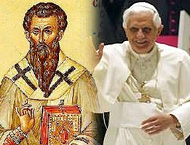
Benedict meets Bakhtin: Towards a Catholic Theory of Literature


In my last post, about Catholicism and the novel, I asked how we might approach the novel from a Catholic perspective. Pope Benedict hasn't, as far as I am aware, addressed this issue directly but he has, perhaps, given us some pointers to work with in his post-synodal exhortation, Verbum Domini.

Time and again he returns in this document to the theme of dialogue: "The novelty of biblical revelation," he writes, "consists in the fact that God becomes known through the dialogue which he desires to have with us."

Now that's a pretty remarkable statement but what's it got to do with the novel? Well, the most obvious link is with the great Russian theorist, Mikhail Bakhtin, who saw the novel as essentially dialogic; it contains a multiplicity of voices competing with each other.

Bakhtin's dialogism and Benedict's may seem to be quite different beasts but the links are certainly worth exploring. For the pope, what matters fundamentally is that "our whole existence becomes a dialogue with the God who speaks and listens, who calls us and gives direction to our lives" whereas, for Bakhtin, it is the, necessarily limited, voices within the novel which matter.

However, Bakhtin does not argue that the text is a self-contained entity or that the author is dead. "Of course, this play with languages (and frequently the complete absence of a direct discourse of his own)," he writes, "in no sense degrades the general, deep-seated intentionality, the overarching ideological conceptualization of the work as a whole."

An Evelyn Waugh novel presents a fundamentally different view of the world from a Thomas Hardy novel; the "
overarching ideological conceptualization" of their books differs enormously. 

But we could go further. According to Bakhtin, it is not just the author but the reader who impinges upon the text. Indeed, it may be that, for Catholics, the true significance of the novel lies in the ways we read it, in what Bakhtin called the "ideological becoming" of the reader. Rather than get sucked into an argument with Orwell about how many Catholics have been good novelists, we can instead approach the novel from the opposite direction. It is what the novel does to us that matters.

There's much more to Bakhtin (and Benedict) than I have set out here but that's probably enough for one post.

Tuesday, 24 January 2012

Catholicism and the Novel

In recent years Pope Benedict has had a lot to say about Catholicism and literature, focussing primarily on the way of beauty, the via pulchritudinis - see here, here, and, for a contextual discussion, here - and mentioning poetry more often than the novel.

And it is not just his speeches either: just before Christmas it was a poet, José Tolentino Mendonça, rather than a novelist who was appointed as a consultor to the Pontifical Council for Culture.

There are many possible reasons for this focus on poetry - perhaps, one might speculate, poetry is a more obvious vehicle for the Way of Beauty than the unruly novel - but it does leave the relationship between Catholicism and the novel somewhat unexplored.

Some writers and critics would have us believe that the novel is fundamentally uncatholic. George Orwell, for example, famously asked "how many Roman Catholics have been good novelists? Even the handful one could name have usually been bad Catholics. The novel is practically a Protestant form of art; it is a product of the free mind, of the autonomous individual.'' ('Inside the Whale')

And more recently Valentine Cunningham, Professor of English Language and Literature at Oxford University, claimed that novels "have rights to that designation only insofar as they display their origins in and their debt to the Northern European Protestant matrix; they have, as it were, the matching DNA."

However, as Peter Marshall has pointed out in The Reformation: A Very Short Introduction, Orwell's claim "is difficult to endorse historically, partly because the Reformation was not noticeably in favour of free minds or autonomous individuals, and partly because some of the best early examples of what we now think of as novels - Miguel Cervantes' Don Quixote (1605) or Hans von Grimmelhausen's Simplicissimus (1688) - were the work of Catholic authors."

And the same is true in later centuries: it doesn't take long to find highly significant novels by Catholic authors - like Alessandro Manzoni's The Betrothed - even before the great Catholic literary revivals of the 20th Century.

Or we could go further back into literary history. Margaret Anne Doody challenges the views of critics like Ian Watts (and Valentine Cunnigham) by arguing, in The True History of the Novel, that the origins of the novel can be found not in post-Protestant England but in classical antiquity.

Nonetheless, it certainly is possible to see the novel as a secular or Protestant form that has been taken up and shaped on occasion by Catholics, to see it, in Georg Lukács's famous phrase, as "the epic of a world that has been abandoned by God." Unlike The Divine Comedy or the Arthurian legends, say, the novel tends to deal with the struggles of individuals in this very human world.

But does this matter? How are we to analyse the novel from a Catholic perspective? These are complicated issues which I shall attempt to explore in my next post.

Thursday, 19 January 2012

The Guardian Style Guide


The Guardian Style Guide is very useful but, as The Guardian would be the first to admit, it's not perfect. It has some very useful advice for budding journalists and, indeed, for all writers and is well worth using in the classroom but it also has one or two blindspots.

However, I did wonder what it had to say about the Catholic Church and this is what I found:

Catholic church

but if you mean Roman Catholic, say so

Which didn't seem very helpful. So I looked up Roman Catholic and this is what I found:  

Roman Catholic

The archbishop of Birmingham, Cardiff, Glasgow, Liverpool, St Andrew's, Southwark and Westminster: it is not normally necessary to say Roman Catholic (as there is no Anglican equivalent). 

The Roman Catholic bishop of Aberdeen, Argyll, Lancaster, Plymouth, Portsmouth, Shrewsbury (for all of which there are Anglican bishops). 

Unless obviously Roman Catholic from the context, say the Roman Catholic bishop of Brentwood, Clifton, Dunkeld, Galloway, Hexham and Newcastle, Leeds, Menevia, Middlesbrough, Motherwell, Northampton, Nottingham, Paisley and Salford. 

In a UK setting use Roman Catholic in describing Roman Catholic organisations and individuals and wherever an Anglican could argue ambiguity (eg "the Catholic church"). But Catholic is enough in most overseas contexts, eg Ireland, France, Italy, Latin America

But I suppose we should be grateful for small mercies. In 1928 neither "Catholic" nor "Roman Catholic" made it into the guide at all.

Tuesday, 17 January 2012

Tolkien and Chesterton

There is a fascinating book by Alison Milbank, on Chesterton and Tolkien as Theologians which is reviewed here. There is also an interview with the author here in which she makes the fascinating points like these:

"Tolkien says that Chestertonian fantasy shows you the actual world from a new angle but thoroughgoing fantasy is like opening a box that allows out new things and releases them from our ownership of them. This is a really philosophical statement. The Enlightenment philosopher Kant said we have no access to things in themselves, and all we have is our own perception of the world. This leads to an alienated form of knowledge. Tolkien, following Chesterton, is a realist in a philosophical sense, because he thinks that we can be aware of a world beyond our own perceptions. Paradoxically, fiction – creating your own fantasy world – is not a way of owning your own private reality but setting the things in that world free – like Tom Bombadil putting the contents of the barrow-wights’ hoard out on the hillside."

Tuesday, 10 January 2012

Reclaiming or Renaming the Middle Ages


As I have mentioned before in another context, "medieval" and "the Middle Ages" are loaded terms. As C.S. Lewis puts it in English Literature in the Sixteenth Century: "the very idea of the 'medieval' is a humanistic invention. (According to Lehmann it is in 1469 that the expression media tempestas first occurs.) And what can media imply except that a thousand years of theology, metaphysics, jurisprudence, courtesy, poetry, and architecture are to be regarded as a mere gap, or chasm, or entre-acte? Such a preposterous conception can be accepted only if you swallow the whole creed of humanism at the same time." (p.20)

Unfortunately it seems as though that creed really has been swallowed whole. The Middle Ages are now synonymous with obscurantism, cruelty and myopia. One of the Oxford English Dictionary's definitions of 'medieval' (which, incidentally, is first recorded as late as 1817) is: "Exhibiting the severity or illiberality ascribed to a former age; cruel, barbarous".

But this isn't the only problem. The OED also defines the Middle Ages as "The period in European history between ancient and modern times, now usually taken as extending from the fall of the Roman Empire in the West (c500) to the fall of Constantinople (1453) or the beginning of the Renaissance (14th cent.); the medieval period;esp. the later part of this period, after 1000." These are, of course, arbitrary dates. One of the problems of the term is that it is notoriously vague. When exactly were the Middle Ages? It depends who you ask. 

Or it depends on what is being attacked. Let's look at the first three quotations the OED chooses in support of its definition: 


[1570    J. Foxe Actes & Monumentes (rev. ed.) I. iii. 204/1   The primitiue tyme of the church,‥the middle age, and‥these our latter dayes of the church.]
1605    W. Camden Certaine Poems in Remaines of Greater Worke 2,   I will onely giue you a taste of some of midle age, which was so ouercast with darke clouds, or rather thicke fogges of ignorance.
1624    H. Wotton Archit. sig. ¶4,   After the reuiuing and repolishing of good Literature, (which the combustions and tumults of the middle Age had vnciuillized).


'The Middle Ages', in other words, is not a neutral description. It is not a mere description of an era. It is a convenient term of abuse, a term of abuse often reached for when describing the Church of Rome, which, supposedly, brought the "thicke fogges of ignorance" and, in so doing, "vnciuillized" literature. 


I could go through example after example of great learning and great literature from c500 to 1453 but, even if I did so, the words "medieval" and "the Middle Ages" would remain. So we have a choice. Either we attempt to reclaim the Middle Ages from those who would see those wonderful, diverse centuries as "cruel" and "barbarous" - by using sites such as this one in our teaching - or we try to rename them. Or, perhaps, we just point out the ways in which we can be manipulated by the language. Either way we have a huge task in front of us.

Monday, 9 January 2012

Chinese Books of the Year

OK, I realise I'm a year late but I don't read the People's Daily that often :)

This time last year the paper chose Canticle to the Land by Catholic novelist, Fan Wen, as one of its Top 5 novels of the year.

There are howls of anguish about the (supposed) demise of the Catholic novel in the English-speaking world so it's good to see that the situation isn't so bleak in the People's Republic.

To read more about Fan Wen's work click here or here. There are no plans for an English translation at the moment but, I hope, a French translation may be published later this year.

Saturday, 7 January 2012

Golem, Gollum and Superman


While teaching Frankenstein, I showed some of my students this video from the National Theatre about man-made creatures.

I was particularly struck by the section on the Golem, the automaton of Jewish legend, and wondered whether there could be a link with (the homophonic) Gollum from The Lord of the Rings. Others have suggested that there might indeed be a link but it's next to impossible to get hold of the relevant material.

Although Gollum's riddles are deeply rooted in Anglo-Saxon literature, Gollum (like the hobbits themselves) is not. It is perhaps not too fanciful, therefore, to seek his origins elsewhere, though it is also true that it is the Orcs who better fit the model of soulless automata created as hollow imitations of men.

I was also intrigued by Dr Nadia Valman's suggestion that the Golem legend evolved in the face of anti-semitic attacks, with the Golem coming to be seen as a super-heroic protector of the embattled Jewish community, and Superman himself being the creation of two Jewish cartoonists in the 1930s. It's amazing where English lessons can take you.

Thursday, 5 January 2012

Waugh in Context

There's an interesting article by Paul Johnson in the January/February edition of Standpoint on 'Novelists at arms'. It dwells slightly too much for my taste on the inspiration for Waugh's characters in The Sword of Honour trilogy, but it does at least put Evelyn Waugh's novels about World War II in some sort of literary context.

I'd want to take this contextual analysis further. Johnson doesn't mention Catch-22 or Slaughterhouse 5, for example, let alone the perspective of other nationalities. Mo Yan's Red Sorghum (and even J.G. Ballard's Empire of the Sun) gives a much needed Chinese perspective on the wars of the 1930s and 40s. But you can't have everything and what he gives us is well worth reading.

Wednesday, 4 January 2012

Evelyn Waugh and the Mass; OUP and the Catholic Tradition


There have been some interesting reviews in the last two editions of The Catholic Herald. In the December edition, Joseph Pearce wrote a review article on the updated edition of A Bitter Trial, Evelyn Waugh's responses to the liturgical innovations of his last years. As I wrote last year, Waugh now seems remarkably prescient and this book sets out his views admirably.


And then, in the Christmas edition, Aidan Nichols favourably reviewed a new anthology of English Catholic writing, published by Oxford University Press and edited by John Morrill, John Saward and Michael Tomko: Firmly I Believe and Truly

This looks like a great book and my only reservation is the start date: 1483. I understand the practical constraints - the anthology runs to over 700 pages as it is - but, nonetheless, many centuries of Catholic England and many great Catholic writers go unexplored in this, as in so many other, anthologies. But I mustn't be churlish: this looks as though it's a must-have anthology.

Tuesday, 3 January 2012

Belloc and the Nature of Belief

Here is another of Belloc's purple passages from The Path to Rome on "the nature of Belief":

"Of its nature it breeds a reaction and an indifference. Those who believe nothing but only think and judge cannot understand this. Of its nature it struggles with us. And we, we, when our youth is full on us, invariably reject it and set out in the sunlight content with natural things. Then for a long time we are like men who follow down the cleft of a mountain and the peaks are hidden from us and forgotten. It takes years to reach the dry plain, and then we look back and see our home.

"What is it, do you think, that causes the return? I think it is the problem of living; for every day, every experience of evil, demands a solution. That solution is provided by the memory of the great scheme
which at last we remember. Our childhood pierces through again... But I will not attempt to explain it, for I have not the power; only I know that we who return suffer hard things; for there grows a gulf between us and many companions. We are perpetually thrust into minorities, and the world almost begins to talk a strange language; we are troubled by the human machinery of a perfect and superhuman revelation; we are over-anxious for its safety, alarmed, and in danger of violent decisions.

"And this is hard: that the Faith begins to make one abandon the old way of judging. Averages and movements and the rest grow uncertain. We see things from within and consider one mind or a little group as a salt or leaven. The very nature of social force seems changed to us. And this is hard when a man has loved common views and is happy only with his fellows.

"And this again is very hard, that we must once more take up that awful struggle to reconcile two truths and to keep civic freedom sacred in spite of the organization of religion, and not to deny what is certainly true. It is hard to accept mysteries, and to be humble. We are tost as the great schoolmen were tost, and we dare not neglect the duty of that wrestling.

"But the hardest thing of all is that it leads us away, as by a command, from all that banquet of the intellect than which there is no keener joy known to man.

"I went slowly up the village place in the dusk, thinking of this deplorable weakness in men that the Faith is too great for them, and accepting it as an inevitable burden. I continued to muse with my eyes upon the ground...

"There was to be no more of that studious content, that security in historic analysis, and that constant satisfaction of an appetite which never cloyed. A wisdom more imperative and more profound was to put a term to the comfortable wisdom of learning. All the balance of judgement, the easy, slow convictions, the broad grasp of things, the vision of their complexity, the pleasure in their innumerable life--all that had to be given up. Fanaticisms were no longer entirely to be despised, just appreciations and a strong grasp of reality no longer entirely to be admired.

"The Catholic Church will have no philosophies. She will permit no comforts; the cry of the martyrs is in her far voice; her eyes that see beyond the world present us heaven and hell to the confusion of our human reconciliations, our happy blending of good and evil things.

"By the Lord! I begin to think this intimate religion as tragic as a great love. There came back into my mind a relic that I have in my house. It is a panel of the old door of my college, having carved on it my college arms. I remembered the Lion and the Shield, Haec fuit, Haec almae janua sacra domus. Yes, certainly religion is as tragic as first love, and drags us out into the void away from our dear homes.

"It is a good thing to have loved one woman from a child, and it is a good thing not to have to return to the Faith."

Monday, 2 January 2012

Belloc on the Mass


As I mentioned in my last post, I'm reading Belloc's The Path to Rome, which is full of wonderful purple passages. Here, for example, is what he has to say about "a day one has opened by Mass ... [which is] a source of continual comfort to me".


"This comfort I ascribe to four causes ... and these causes are:


1. That for half-an-hour just at the opening of the day you are silent
and recollected, and have to put off cares, interests, and passions in
the repetition of a familiar action. This must certainly be a great
benefit to the body and give it tone.

2. That the Mass is a careful and rapid ritual. Now it is the function
of all ritual (as we see in games, social arrangements and so forth)
to relieve the mind by so much of responsibility and initiative and to
catch you up (as it were) into itself, leading your life for you
during the time it lasts. In this way you experience a singular
repose, after which fallowness I am sure one is fitter for action and
judgement.

3. That the surroundings incline you to good and reasonable thoughts,
and for the moment deaden the rasp and jar of that busy wickedness
which both working in one's self and received from others is the true
source of all human miseries. Thus the time spent at Mass is like a
short repose in a deep and well-built library, into which no sounds
come and where you feel yourself secure against the outer world.

4. And the most important cause of this feeling of satisfaction is
that you are doing what the human race has done for thousands upon
thousands upon thousands of years. This is a matter of such moment
that I am astonished people hear of it so little. Whatever is buried
right into our blood from immemorial habit that we must be certain to
do if we are to be fairly happy (of course no grown man or woman can
really be very happy for long--but I mean reasonably happy), and, what
is more important, decent and secure of our souls. Thus one should
from time to time hunt animals, or at the very least shoot at a mark;
one should always drink some kind of fermented liquor with one's
food--and especially deeply upon great feast-days; one should go on
the water from time to time; and one should dance on occasions; and
one should sing in chorus. For all these things man has done since God
put him into a garden and his eyes first became troubled with a soul.
Similarly some teacher or ranter or other, whose name I forget, said
lately one very wise thing at least, which was that every man should
do a little work with his hands.

Oh! what good philosophy this is, and how much better it would be if
rich people, instead of raining the influence of their rank and
spending their money on leagues for this or that exceptional thing,
were to spend it in converting the middle-class to ordinary living and
to the tradition of the race. Indeed, if I had power for some thirty
years I would see to it that people should be allowed to follow their
inbred instincts in these matters, and should hunt, drink, sing,
dance, sail, and dig; and those that would not should be compelled by
force.

Now in the morning Mass you do all that the race needs to do and has
done for all these ages where religion was concerned; there you have
the sacred and separate Enclosure, the Altar, the Priest in his
Vestments, the set ritual, the ancient and hierarchic tongue, and all
that your nature cries out for in the matter of worship."


Later on, he describes going to Mass on the feast of Corpus Christi and comments approvingly that "the Mass was low and short - they are a Christian people". 


I don't want to draw any facile conclusions but it seems that, for Belloc, "the sacred and separate Enclosure, the Altar, the Priest in his Vestments, the set ritual, the ancient and hierarchic tongue" were not incompatible with the "low and short". For him the Mass could be both "careful" and "rapid".


But all this is to see Belloc with early 21st Century eyes. What really mattered then, as it matters now, was the Mass itself and its "continual comfort".

Sunday, 1 January 2012

A New Year Message from Hilaire Belloc


Since everybody else seems to be giving a New Year message, I thought I'd give Belloc a chance.

This is from his 1902 The Path to Rome, which I'm reading at the moment in the wonderful Penguin edition:

"Then I went on my way, praying God that all these rending quarrels might be appeased. For they would certainly be appeased if we once again had a united doctrine in Europe, since economics are but an expression of the mind and do not (as the poor blind slaves of the great cities think) mould the mind."

Saturday, 31 December 2011

New Year


Here's a great New Year poem from Denise Levertov.

You can also see and hear her reading some of her poems here.

Wednesday, 28 December 2011

José Tolentino Mendonça

A couple of weeks ago the Pope appointed new members and consultors to the Pontifical Council for Culture


What was interesting about these appointments was a) how wide-ranging the Vatican's definition of Culture is (among the consultors were professors of neurology, physics, and astrophysics) b) how high profile some of these appointments were (Arvo Pärt being the standout figure) and c) how poets rather than novelists represented the literary arts.


I will write shortly about Catholicism and the novel but, for now, let's look at the poet (and theologian) who was named as a consultor, Fr José Tolentino Mendonça. You can read about his work here and can read one of his poems (which is partly about Flannery O'Connor) here.


If you ever need a lesson on how to not use the comma, Mendonça's the man.

Wednesday, 21 December 2011

Image Journal: Poems for the Season


Image Journal is an interesting publication with an interesting blog. If you're looking for some festive poems they have some good recommendations here.

Sunday, 18 December 2011

The Father Christmas Letters


Tolkien's The Father Christmas Letters - also published in more detail as Letters from Father Christmas - are quite fun, though not in anything like the same league as The Lord of the Rings. The title is also slightly misleading. The letters are indeed from Father Christmas (to Tolkien's children) but Father Christmas is not quite as significant in most of the letters as the North Polar Bear, his accident-prone helper, though I suspect that it is Tolkien's pictures rather than his tales or his characters which are the chief attraction for many children.

I was intrigued by one minor detail though. Tolkien is very precise about the date of the last major Goblin attack - 1453 - which rather suggests a link with the Ottoman Turks who famously stormed Constantinople in that year. Now we have to be careful here: Tolkien claimed to hate allegory (though there is more than a whiff of it in stories like Farmer Giles of Ham and the wonderful Leaf by Niggle). The simple fact that the Goblins return to the North Pole during the dark days of World War II suggests that we cannot simply equate the Goblins with the Ottoman Turks. However, this simple fact also suggests that Tolkien's imagination was rather more allegorical than he sometimes claimed or would have liked.

One word of warning. You don't get all the letters in The Father Christmas Letters or even, I think, in some editions of Letters from Father Christmas, which can be rather frustrating.

Indeed, despite the enormous number of books published by and about Tolkien, there are still some gaps. I look forward to the day, for example, when we get a Collected Letters. What we have at the moment is only a selection with some significant lacunae. Take this example, for instance:

"Out of the darkness of my life, so much frustrated, I put before you the one great thing to love on earth: the Blessed Sacrament..... There you will find romance, glory, honour, fidelity, and the true way of all your loves upon earth, and more than that: Death: by the divine paradox, that which ends life, and demands the surrender of all, and yet by the taste (or foretaste) of which alone can what you seek in your earthy relationships (love, faithfulness, joy) be maintained, or take on that complexion of reality, of eternal endurance, which every man's heart desires."(pp.53-54)

I'd love to know what comes at the end of that first sentence. But, even with the gaps, these letters are really wonderful.

Monday, 12 December 2011

Dickens, Chesterton & Christmas


G. K. Chesterton wrote a series of brilliant introductions to Dickens' books, including his Christmas books, which are well worth reading at this time of year. You can find the relevant introductions here and here.

As you might guess, they are eminently quotable, so I have had to restrict myself to just a few of Chesterton's comments here. 

What he appreciates is that "Dickens devoted his genius in a somewhat special sense to the description of happiness. No other literary man of his eminence has made this central human aim so specially his subject matter." 

Which is why he was so attracted to Christmas, almost despite himself: "All Dickens's books," he writes,  "are Christmas books."

So what is so special about Christmas?

"Everything is so arranged that the whole household may feel, if possible, as a household does when a child is actually being born in it. The thing is a vigil and a vigil with a definite limit. People sit up at night until they hear the bells ring. Or they try to sleep at night in order to see their presents the next morning. Everywhere there is a limitation, a restraint; at one moment the door is shut, at the moment after it is opened. The hour has come or it has not come; the parcels are undone or they are not undone; there is no evolution of Christmas presents."

And why does the season matter?

"All comfort must be based on discomfort. Man chooses when he wishes to be most joyful the very moment when the whole material universe is most sad."

As he wrote about Dickens: "He may almost be said to have only written a brilliant introduction to another man's book."

Thursday, 8 December 2011

How to Read


I love this passage about reading from Steinbeck's East of Eden: "Samuel rode lightly on top of a book and he balanced happily among ideas the way a man rides white rapids in a canoe. But Tom got into a book, crawled and grovelled between the covers, tunnelled like a mole among the thoughts, and came up with the book all over his face and hands."

This thought from the Sayings of Light and Love by St John of the Cross (who is quoting Guigo the Carthusian who is, in turn, reworking Luke 11: 9) is wonderful in a different way: "Seek in reading and you will find in meditation; knock in prayer and it will be opened to you in contemplation." 

This fourfold approach is the basis of lectio divina but, it seems to me, it also has an application in the classroom. As English teachers we want our students to read but how they read is pretty important too.

Wednesday, 7 December 2011

Regina Derieva


Regina Derieva is an interesting poet. She was born in what is now Ukraine in 1949 and lived for many years in what is now Kazakhstan before converting to Catholicism, emigrating to Israel and then finding herself in a stateless condition. She now lives in Sweden and continues to publish to critical acclaim.

Thursday, 1 December 2011

Making the Most of Advent


This time last year I recommended the poetry of St Robert Southwell (and here) and Alice Thomas Ellis's The Birds of the Air

This year I have been slogging through her The Inn at the Edge of the World, a novel about a group of individuals who spend Christmas at a failing inn on a remote Scottish island in a vain attempt to escape the horrors of Christmas. As is typical of Thomas Ellis, there is more to the story than immediately meets the eye - selkie legends run through the story and a twist is coming - but I'm not enjoying it as much as I did The Birds of the Air simply because the characters are an eminently unlikeable lot.

So what else is available as we prepare for Christmas? I recommended a few books last November and a couple of children's books this year (here and here) but there's plenty more out there.

Denise Levertov's 'The Tide', for example, is presented as an Advent poem in one anthology of Catholic poetry. It's a good poem but I wonder if her poem about the Annunciation might not be a better bet at this time of year (as well as in March)? Levertov is a fantastic poet and not terribly well known, at least on this side of the pond.

Another option is Mauriac's 'A Christmas Tale', a story about Christmas, growing up and authorship, which is available in John B. Breslin's The Substance of Things Hoped For (along with some other great, and unusual, short stories.

Any other suggestions gratefully received.

Sunday, 27 November 2011

Rowan Williams meets Dostoevsky: Towards a Catholic Theory of Literature

In the introduction to his book about Dostoevsky: Language, Faith and Fiction, Rowan Williams, the Archbishop of Canterbury, writes about "Evelyn Waugh and Graham Greene (at least in much of his earlier work) as Catholic novelists, and we mean by this not that they are novelists who happen to be Catholics by private conviction, but that their fiction could not be understood by a reader who had no knowledge at all of Catholicism and the particular obligations it entailed for its adherents. Quite a lot of this fiction deals with what it is that makes the life of a Catholic distinct from other sorts of lives lived in Britain and elsewhere in the modern age. ... Some of it is about how the teachings of the Catholic Church, difficult and apparently unreasonable as it seems, is obscurely vindicated as the hand of God works through chaotic human interactions."

That last sentence is enough to make the hackles rise but, even if we discount it, Williams' definition seems rather curious. These novelists are Catholic but not catholic. They are defined by their differences. Their vision is narrow.

But surely that is simply not the case. Both Greene and Waugh are read and enjoyed by many readers who have very little interest in, sympathy for, or knowledge of, Catholicism. As Catholics, their vision was wide enough to take in everything from gang warfare to relics, from politics to humour, from heaven to hell and everything in between.

This is precisely why Greene so disliked being labelled as a "Catholic novelist". But, if we are to reach towards a Catholic theory of literature, we have not only to be catholic in our own reading (as I suggested in my last post) but we have to allow Catholic novelists (and poets) to be catholic too. If Catholicism means anything at all it means everything.

To be fair to Williams, he does at least identify another type of Catholic novelist - represented by Flannery O'Connor, Walker Percy, Muriel Spark, and Alice Thomas Ellis - whose books are less obviously Catholic but whose "work is about the possibility of any morally coherent life in a culture of banality and self-deceit." Williams feels more at home with this second group but, in using them as a way into Dostoevsky, he surely does a great disservice to Greene and Waugh.

But I mustn't end on a negative. It is encouraging to English teachers everywhere that both the Pope and the Archbishop of Canterbury are prepared to spend time reading and writing. In fact Rowan Williams thought this one was so important that he took a sabbatical to write it.

If you want to read more about his book click here or here or here.

Monday, 21 November 2011

Benedict meets Basil: Towards a Catholic Theory of Literature

Is it possible to have a Catholic theory of literature?

Over the next few weeks I shall try to explore a few different approaches, starting with one suggested by Pope Benedict in his General Audience on St Basil:

"Basil," he said, "was of course also concerned with that chosen portion of the People of God, the youth, society's future. He addressed a Discourse to them on how to benefit from the pagan culture of that time.

He recognized with great balance and openness that examples of virtue can be found in classical Greek and Latin literature. Such examples of upright living can be helpful to young Christians in search of the truth and the correct way of living (cf. Ad Adolescentes 3).

"Therefore, one must take from the texts by classical authors what is suitable and conforms with the truth: thus, with a critical and open approach - it is a question of true and proper "discernment"- young people grow in freedom.

"With the famous image of bees that gather from flowers only what they need to make honey, Basil recommends: "Just as bees can take nectar from flowers, unlike other animals which limit themselves to enjoying their scent and colour, so also from these writings... one can draw some benefit for the spirit. We must use these books, following in all things the example of bees. They do not visit every flower without distinction, nor seek to remove all the nectar from the flowers on which they alight, but only draw from them what they need to make honey, and leave the rest. And if we are wise, we will take from those writings what is appropriate for us, and conforms to the truth, ignoring the rest" (Ad Adolescentes 4).

"Basil recommended above all that young people grow in virtue, in the right way of living: "While the other goods... pass from one to the other as in playing dice, virtue alone is an inalienable good and endures throughout life and after death" (Ad Adolescentes 5).

"Dear brothers and sisters, I think one can say that this Father from long ago also speaks to us and tells us important things.

"In the first place, attentive, critical and creative participation in today's culture.

"Then, social responsibility: this is an age in which, in a globalized world, even people who are physically distant are really our neighbours; therefore, friendship with Christ, the God with the human face.

"And, lastly, knowledge and recognition of God the Creator, the Father of us all: only if we are open to this God, the common Father, can we build a more just and fraternal world."

To read the whole of St Basil's Address to Young Men on the Right Use of Greek [i.e. pagan] Literature click here.